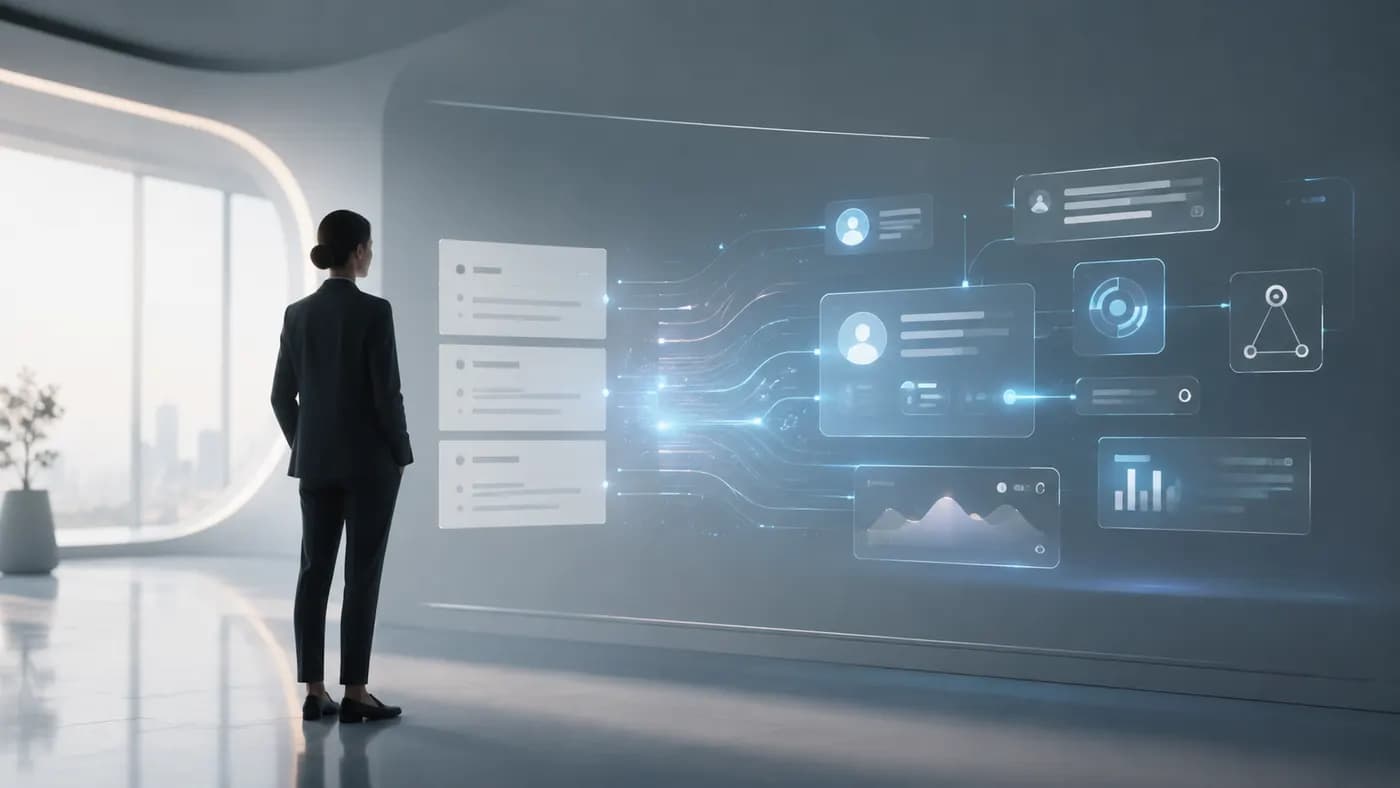
Social Intranet: How Do You Make a Company Visible to Its Own Employees?
How does company culture emerge when nobody walks through the same office door? How a social intranet achieves more than any mission statement.
Published on 31 min readTopic: Leadership, culture & the world of work
- Intranet
- Company culture
- AI
- Distributed
- Expertise
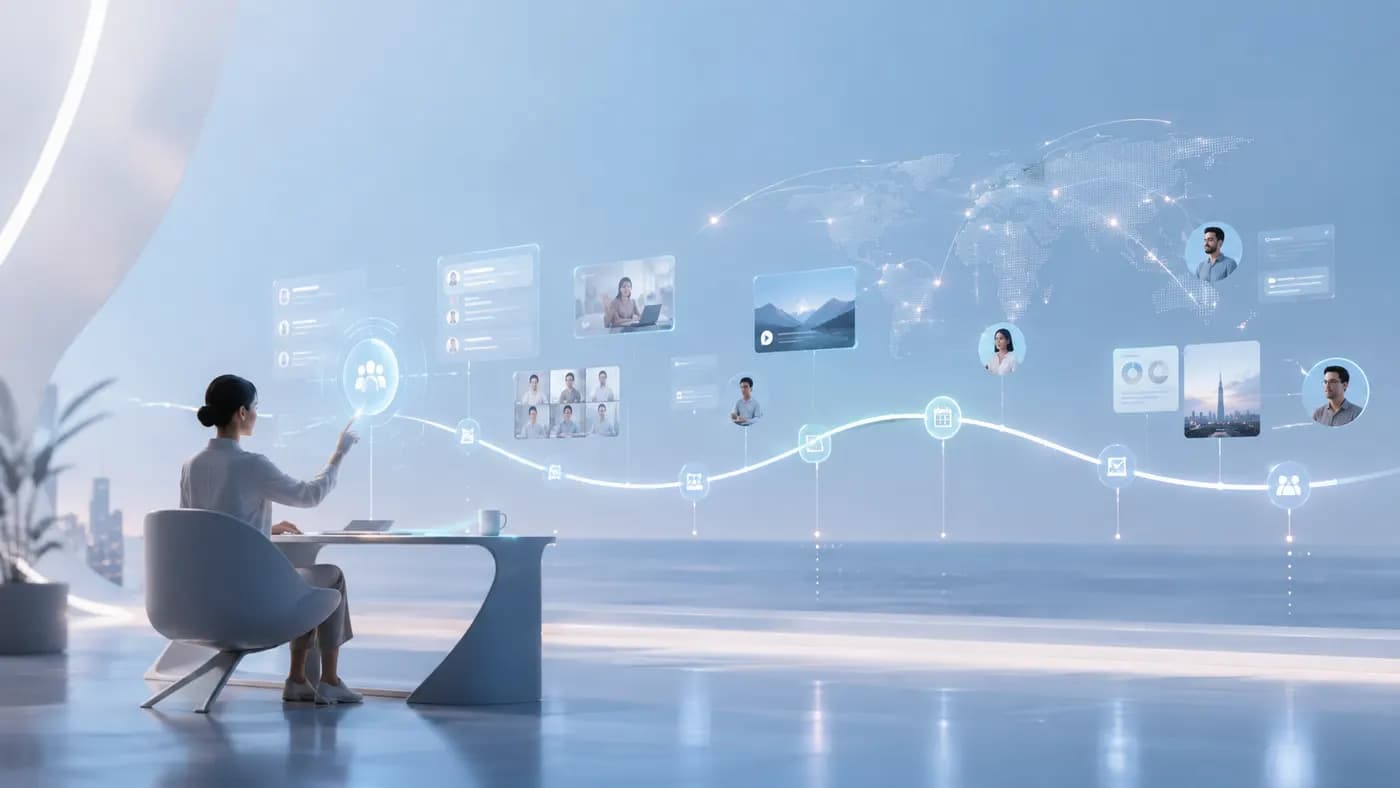
For many years I have been working on the question of how companies can connect their employees across different locations, countries and time zones. Not in theory, but because we have worked in a distributed way ourselves for years and have also built such structures at companies whose employees are deliberately spread across several branches, countries and, in some cases, different languages.
The problem is rarely communication in the narrow sense. Anyone can send emails, video conferencing now works everywhere and there is plenty of software for projects.
The harder question is: How does company culture actually emerge in a distributed company?
How does an employee in another branch find out what the team in Germany is currently working on? How does a colleague in Austria learn that another team has just solved a problem she could have helped with? How does a new employee get to know people they have never met in a meeting? And how do you prevent a situation where everyone works brilliantly on their own project but hardly notices anything about the rest of the company?
It was at this question that a comparison came to mind which sounds somewhat absurd at first: Why do Instagram, LinkedIn, TikTok and other social networks manage to get us to open them voluntarily several times a day, while many employees only visit their own intranet when they urgently need a form, a phone number or some policy?
Of course, nobody wants employees to scroll through internal cat videos for hours, and the partly deliberate addictiveness of social networks is certainly not a model to simply copy. But the mechanics behind it are, from a business point of view, extremely interesting.
Social media manages to turn many small events into the feeling of being part of a living world. A new post. A short video. A reaction. A comment. A question. A person you know. Something that is happening right now.
You do not necessarily open the app because you are looking for a particular piece of information. You open it because you want to know what has happened. And this is exactly what many classic intranets lack. They answer the question “Where do I find information X?”, but hardly the far more important question: “What is happening in my company right now?”
This observation has strongly influenced how we think about internal communication over the years. We have therefore increasingly used structures, first in our own company and later with customers, that are much closer to a social network than to a classic corporate intranet. At the centre is a shared company timeline that is not separate from the actual work but connected to it.
New projects can become visible there. Tasks, comments, polls, events, short videos, new colleagues, important decisions, successes, learnings, open questions or also problems where a team needs support.
And the crucial point: a post does not necessarily end as a post. A discussion can directly turn into a task. A vote into a decision. An event into an appointment. A project milestone into a message to the relevant employees. A question can produce knowledge that can be found again later. This turns the intranet from a digital notice board into a kind of social user interface of the company.
After several years with such structures, I consider one point particularly important: In distributed organisations, company culture does not emerge because five company values have been published somewhere. It emerges from what employees see and experience every day.
Who is praised? Which projects receive attention? How openly are problems discussed? How does management react to mistakes? Which teams help each other? And does an employee in one branch really get the feeling of being part of the same company as a colleague working several thousand kilometres away?
That is exactly why I find social intranets considerably more interesting than their somewhat old-fashioned name suggests. At its core, it is not about an intranet at all, but about the question: Can the mechanics with which social networks create communities be used deliberately for company culture and collaboration?
What if day-to-day business itself created the content? What if an employee did not have to open five different systems in the morning but saw a personal company timeline showing what has really become relevant since yesterday? What if AI picked the five events that actually concern this person out of a hundred? What if a new employee knew thirty colleagues after four weeks, even though they had never had a video call with most of them?
What actually is a social intranet?
By a social intranet I explicitly do not mean a classic intranet with an added comment function. That would be roughly like screwing a like button onto a filing cabinet and then claiming to have built a social network.
A good social intranet connects communication with the actual day-to-day business. At its centre is a personal or company-wide timeline. It shows not only company announcements but things that happen anyway: A new project starts. A colleague joins the company. An important milestone has been reached. A team needs support. A poll is running. An internal event is coming up. A customer has given particularly positive feedback. A question is being discussed. A managing director explains a decision. An employee shows in a short video what their team is currently working on.
And these very things, taken together, depict the company. Not in the abstract, but in motion.
Why classic intranets often fail in distributed companies
For a long time, the classic intranet was above all a repository: policies, downloads, forms, organisation charts, phone numbers, perhaps a few news items. All sensible in principle, but hardly anyone opens such a system voluntarily in the morning thinking “Let’s see what is happening in my company today”.
That is exactly the difference: a classic intranet waits for someone to look for information. A social intranet brings relevant information to the employee. That sounds like a small difference at first, but it changes the whole way the system is used. People are interested not only in information they are already looking for. They are also interested in things they did not know were relevant. And that is precisely the effect social networks have perfected.
Can the doom-scrolling effect be used sensibly in companies?
Of course not in the sense of artificially created dependency. Nobody should maximise the metric “time in the internal feed”; after all, a company earns nothing if an employee spends an hour consuming internal posts.
But the mechanics behind doom scrolling are interesting nonetheless. People respond to timeliness, to surprise, to people, to visual content, to stories, to open questions, to the feeling that something is happening, and to things they did not actively look for. These very principles can be transferred, not to keep employees hooked for longer, but to make relevant communication easier to see.
The real metric is therefore not “How long does someone scroll?” but “Has the employee seen what matters to them?” Have they found a colleague who can help? Has a question received an answer? Has a discussion turned into a concrete task? Has an employee understood what is currently happening in another part of the company?
Day-to-day business itself has to become the content
This is one of the most important insights from our practical work with such structures. A social intranet cannot live on an internal communications department having to think every morning “What do we post today?”. That only creates one more channel that eventually stops being maintained.
The company itself has to supply the material: a project starts, a team reaches a milestone, a new product is being developed, an employee joins, a difficult problem has been solved, a customer gives interesting feedback, a decision changes a process. All of that is relevant.
Of course, not every technical system message may automatically be flushed into a feed. Otherwise an employee sees in the morning: “Peter completed task 458. Maria uploaded file version 13. System X changed status to Y.” Congratulations, we have married SAP with Instagram and produced the worst of both worlds.
The decisive point is therefore the editorial logic: What is really interesting? What concerns this person? What should the whole company know? What is only relevant for one project? What can be summarised? And what can disappear completely?
Why agile ways of working fit a social intranet surprisingly well
Many agile mechanisms are based, at their core, on something that is also decisive for a good social intranet: making work visible. A Kanban board does not work because colourful cards look particularly modern. It works because a team can see at a glance what is open, what is being worked on and what has been completed.
It is similar with short daily updates, reviews or retrospectives. They regularly create small windows into the work: What have we achieved? What is blocking us? What have we learned? This information can become valuable in a social company environment if it is not locked away in endless meetings.
A team completes a sprint and does not publish the entire report, but perhaps three things: What did we achieve? What did we learn? Where do we need support? Suddenly a classic sprint review also becomes a cultural signal. Other teams see not only the result, they see how this team works and learns.
A blocker can stay within the project. Or, where it makes sense, it can become visible and reach a colleague in another branch who already knows exactly this problem. This creates a link between agile working and company culture: agile project management brings short feedback cycles into projects, and a social intranet can partly extend these feedback cycles to the whole company. Not by making every task public, but by making relevant progress, blockers, learnings and decisions visible.
What if the company had its own algorithm?
This is one of my favourite thought experiments. Imagine your company’s algorithm were optimised not to hold your attention for as long as possible, but to keep you as well informed as possible.
In the morning, an employee opens their working environment and sees not 117 notifications but perhaps: “Five things have happened since yesterday that are relevant to you.” A customer has responded to an offer. A project has been postponed. A colleague at another site has solved a problem that matches your current task. A new internal rule affects your area. And this afternoon there is a session that might be interesting given your current project. Below that, perhaps: “Would you like details?”
That would be an algorithm optimised not for attention but for connection and action. And in my view, that is where a rather exciting future of internal communication lies.
How can you build company culture across several countries?
The more international a company becomes, the harder culture gets. Not necessarily because people are fundamentally different, but because many small connections are lost. In a classic office, chance moments of information arise all the time: you see someone, you overhear something, you walk through a department, you talk over lunch.
In a company with employees in Germany, Austria, Asia or the Middle East, this chance proximity does not exist. So it has to be partly recreated digitally. A shared feed can ensure that an employee in Austria regularly notices what a team in Germany is working on. A colleague in Asia may see a product idea from Europe. Someone in another branch discovers that exactly their experience is needed right now.
This creates an effect that is hard to plan but can be encouraged: serendipity, that is, chance relevant encounters. People discover information they would never have looked for. And this is often where the most interesting connections in a company come from.
Why company culture should not live in a menu item of its own
Many companies treat culture as a separate topic: here is work, there is culture. Here are projects, there is internal communication. I consider this separation artificial.
An employee solves a difficult customer problem: that is culture. A manager openly explains why a decision was wrong: that is culture. A team spontaneously supports another branch: that is culture. An employee is publicly praised for good work: that is culture. A colleague asks an uncomfortable question and gets a constructive answer: that, too, is culture.
Culture emerges in day-to-day business. So why separate it from it?
How a social intranet and task management belong together
For a social intranet not to become a pure communication platform, it must be connected to operational work. If someone writes “For project X we still need someone with experience in this area”, this should be able to turn directly into a task or a participation. If a poll leads to a decision, that decision should be linked to the project. If a discussion creates a new work step, a to-do should result.
That sounds trivial but is decisive. Communication without consequence quickly turns into noise. The social layer only becomes really interesting when communication can lead to action.
A social intranet as an interface above projects, tasks and knowledge
You can picture this architecture almost as different layers. At the bottom is day-to-day business: projects, tasks, customers, documents, appointments, workflows. Above it sits the social layer: What is happening? Who is working on what? Where are there questions? What results are emerging? What does someone need to know?
And above that, an AI layer could sit in future. It filters, translates, summarises, connects information and answers questions. Then a classic intranet slowly begins to disappear, and what emerges is more of a personal company interface.
How does a social intranet work with hundreds of employees?
Especially in larger distributed companies, a naive timeline is of course unsuitable. If 500 employees simply see everything from everyone, chaos results. The system has to understand that different people have different information needs: someone in sales sees different things from someone in IT, a manager different things from a new employee.
At the same time, the feed must not personalise too strongly. If everyone only sees their own area, the very bubble you wanted to break up reappears. A good feed therefore needs both: relevance and controlled chance. Employees see what they need to know, but occasionally also something that might be interesting. That is where new connections arise.
A practical example: three countries work on one project
Let us imagine a project on which teams from Germany, Austria and another international site are working. The actual project work runs cleanly in tasks and responsibilities. In addition, the company feed shows: “Week three: the Austrian team has completed the customer interface.” Perhaps with a 40-second video.
The next day: “This problem came up during testing. Has anyone worked with it before?” A colleague at another site comments. His comment leads to a concrete task. Two days later the solution is documented. The original post stays linked to the discussion, the task and the solution.
For those involved in the project, this is operational work. For other employees, it is at the same time a small window into a part of the company they would normally never have seen. And these side effects are valuable.
From the point of view of agile collaboration, this example is also interesting: the feed can become a light, social complement to sprint reviews or Kanban boards. Not every employee has to see another team’s complete board, but relevant progress, blockers and learnings can pass from the project world into the company world. This spreads not only information but also ways of working. Other teams see that problems are made visible early, that results are presented in short cycles and that feedback is welcome. That, too, is company culture.
A practical example: a new employee starts 8,000 kilometres away
Onboarding is a particular challenge in distributed companies. A new employee classically receives a login, an organisation chart, a few PDFs and several video calls. After two weeks they know their immediate team. But do they really know the company?
In a social company environment, they see different things from the start: a short video from the management, projects of other teams, new employees, successes, problems, internal events, discussions, humour, questions. They recognise names again and again. They see which colleagues often help with particular topics. They notice how people talk to each other, what matters, what is celebrated and which problems are discussed openly.
After four weeks this person may know 30 or 40 colleagues, even though they have never spoken to many of them in person. But they are no longer strangers. And for me that is a central part of digital company culture.
Can a social intranet reduce silos between departments?
Yes, if information is not distributed exclusively along the organisation chart. In classic companies, communication often moves hierarchically: employee, team leader, department head, other department.
A social company network, by contrast, can move information more strongly along topics and expertise. Someone asks a question, and the best answer may not come from the line manager but from a colleague in a completely different department, in another branch or in another country. This makes the company flatter in terms of information, not necessarily organisationally, but knowledge can reach more easily the place where it is needed.
Can you actively influence company culture through a social feed?
Yes, but not by creating culture artificially. Software cannot repair poor leadership. A social intranet does not suddenly turn a bad organisation into a good one. But technology can make existing behaviour more visible and thereby reinforce it.
A company may claim “We help each other.” You can write this value on a PowerPoint slide, or you can see every day how someone asks a question in a project and three colleagues respond within an hour. The difference is enormous.
A company may claim “We work internationally.” But if the internal feed almost exclusively features the head office, employees learn something else: the head office is the real company, the rest are outposts. If, on the other hand, projects and people from different sites are visible, a different picture emerges. Culture is then no longer “What do we claim about ourselves?” but “What do employees see happening every day?”
How agile retrospectives can strengthen company culture
Retrospectives also fit surprisingly well into this idea. In many agile teams people regularly ask: What went well? What went badly? What should we do differently next time? At first this sounds like project management only. In truth it is cultural work, because an organisation that regularly talks openly about what did not work sends a completely different signal from an organisation in which mistakes stay as invisible as possible.
A social intranet can make selected learnings from such retrospectives visible, not the entire internal discussion, but for example: “Three things we learned from this project.” This moves learnings from individual projects into the collective memory of the company. And this is one of the strongest links between agile working and a social intranet: learning becomes visible.
Can you use social media internally for recognition?
Absolutely. In classic companies, many good achievements are noticed by only a few people: a customer praises an employee, the manager knows, perhaps the team, then the moment disappears.
In a social working environment, this can become a small story. Not every piece of praise needs a big ceremony, but visibility changes perception. People see which behaviour is valued. Recognition thereby becomes cultural communication at the same time: not “Our value number three is customer focus”, but “Here is someone who has just done exactly that.”
Should every employee be allowed to post in the social intranet?
In principle I consider openness important. A social intranet in which only the management communicates is not a social network but a digital loudspeaker. The interesting posts often come from employees themselves: experiences, questions, ideas, successes, solutions, photos or videos from other sites.
But of course a company needs rules: What is confidential? What belongs in closed project groups? Which customer information may become visible? Which data is sensitive? What may an AI process? Social does not mean everyone sees everything, but the right people get the right context.
Can videos improve internal company communication?
In my experience: very much. Not every topic needs a long text. After an important meeting, a managing director can record a short video: “Today we decided three things. For you, this means specifically …” A project manager can say: “Quick update from Vienna. The biggest problem this week was X. If you have a similar issue anywhere, get in touch.”
That feels more personal than the classic circular email “Dear colleagues, we would hereby like to inform you …”. People like faces, voices, gestures, humour, emotion. Company culture is allowed to look human even in professional companies.
What would an “internal TikTok” for companies look like?
That sounds almost ridiculous at first. But let us think about the mechanics without the brand behind them: short videos, one idea per piece of content, quick to consume, expert knowledge, learnings, questions, experiences.
Why should a company not develop an internal library of 30, 60 or 90-second experiences? “This is the mistake we made at the customer.” “This is how we solve task X.” “Three things I learned this week.” One employee watches it, another comments, someone adds something, and later it becomes a unit of knowledge. Training then no longer happens only in scheduled courses but in everyday work.
Can a social intranet secure knowledge in the company?
That is another very big advantage. Chat is excellent for quick communication, but knowledge disappears in it just as quickly. On Monday someone asks an excellent question, an experienced employee gives an excellent answer, and on Tuesday that answer is buried somewhere among eighty new messages.
A social company platform, by contrast, can link discussions with topics, projects, people and knowledge. The answer then becomes part of the company’s memory. And this is where AI comes in.
How can AI improve a social intranet?
In my view, AI should above all not produce even more content. Companies rarely have too little information, they have too much. AI should therefore reduce, translate, structure and connect. From 100 system events, five important messages emerge. From a long meeting, a summary. From ten project updates: “These are the three changes that are relevant to you.”
An employee can ask: “What has changed in project X since Friday?” Or: “Who here has experience with topic Y?” Then the social intranet slowly becomes a personal company assistant. At ivato, this is exactly the question we work on: how digital business models and internal systems can be combined sensibly with AI.
What if employees received an AI summary of their company every morning?
An exciting thought experiment: you open your working environment in the morning. It says: “Good morning. Four things have happened since yesterday that are relevant to you.” A customer has responded to your offer. In the Vienna project a deadline has changed. A colleague in Singapore documented a problem yesterday that is similar to your current topic. And the management has published a new internal rule; for you, only point two changes. Below that: “Shall I show you the details?”
That would not be one more chatbot gimmick. That would be real information architecture.
Multilingual company culture: can AI reduce language barriers?
For international companies in particular, language is an underestimated issue. One employee writes in German, another reads in English, a third perhaps in a completely different language. Posts can be translated automatically, videos get subtitles, summaries are produced in each employee’s preferred language.
This removes a barrier that strongly influences company culture. In international organisations, the people who command the shared working language most confidently often dominate automatically. When translation increasingly works in the background, considerably more people can take an active part.
Could there be internal influencers in future?
This, too, is an interesting thought experiment. Every organisation has people whose opinion others take seriously: people who explain well, who are particularly helpful, who motivate others, who share above-average amounts of knowledge.
Why should such people not be made more visible? Not through an absurd internal follower ranking, but by giving knowledge and contributions real reach. Perhaps the most important internal influencer in a company is not the managing director but an experienced colleague who has been able to solve every complicated customer problem for ten years.
Can a social intranet reduce emails?
In part, clearly. Not personal or confidential communication, but a great many internal emails read roughly: “For information to all.” “Please note.” “Who knows about this?” “Please vote.” “Who can help?” Such communication often works better in a shared context, above all because the reply then does not disappear into a private inbox but remains accessible to others.
A thought experiment: the company without internal circular emails
How far could you go? What if circular emails almost completely disappeared? Company information appears in the feed, questions go to suitable communities, project communication is attached to the project, document changes trigger targeted notifications, polls run directly in context, knowledge stays findable.
Perhaps the classic email distribution list will one day look as old-fashioned as a fax does today. Not email itself, but the principle of sending the same information indiscriminately to 200 inboxes.
How do you prevent information overload in a social intranet?
Through radical relevance. Not everything has to become visible, not everyone has to see everything and not every event is interesting. A good system needs at least three levels: I need to know this. Might be interesting for me. Can wait.
AI can play a very large role here. Perhaps the future of internal communication therefore lies not in providing more information but in providing less, but better information.
Can company culture be measured digitally?
Only in part, and you should be very careful not to build a surveillance system out of it. But certain patterns can be interesting: Which sites interact with each other? Which departments stay completely in their own bubble? Which questions remain unanswered? Which topics generate collaboration? Which employees regularly share helpful knowledge?
These are not perfect culture metrics, but they show how knowledge and relationships flow through a company. Perhaps the more interesting metric is therefore not “How many likes do we have?” but “How well is our company connected across organisational boundaries?”
How do you introduce a social intranet without it being dead after three months?
Not as an intranet project. That may sound somewhat paradoxical, but if the project starts with “From 1 October we have a new intranet, here is your login”, you can probably schedule the funeral right away.
People do not use systems because the management bought them. They use systems because things happen there that are relevant to their everyday life. That is why I would not start with the news page but with real work: projects, tasks, events, questions, knowledge, collaboration, onboarding, decisions. The social layer is then added on top. The feed must not be an additional place that employees have to visit alongside their work. It should be part of the interface they pass through constantly anyway.
What role do Kanban, dailies and reviews play in the introduction?
Here I would indeed adopt some mechanisms from agile working. Not because every company should suddenly do Scrum, but because agile methods are very good at bringing communication into short, recurring rhythms. A Kanban board makes progress visible, a daily makes blockers visible, a review makes results visible, a retrospective makes learning visible.
These very four things are also valuable for a social intranet. You could, for example, define that selected project progress passes automatically into the feed. Not every task, but a real milestone, a blocker where help from other teams would make sense, or a learning from a retrospective. This way agile project management does not become an island of its own. The relevant signals flow into the social layer of the company, which strengthens transparency and culture at the same time. The organisation sees not only what a team achieves, it also sees how teams solve problems, use feedback and learn.
Which content works particularly well in a social intranet?
In our experience, a mix of three kinds of content is needed. Operational content keeps the system relevant. Cultural content keeps it human. Strategic content ensures that people understand where the company wants to go.
This can include: project updates, new colleagues, short videos, successes, mistakes and learnings, open questions, customer feedback, internal polls, events, process changes, product ideas, decisions and recognition. If only corporate news appears, it becomes boring. If only system messages appear, it becomes tiring. If only fun posts appear, it becomes irrelevant. The mix creates the feeling: This is where I see my company.
What have we learned from several years of distributed collaboration?
Above all, five things. First: the more distributed a company becomes, the more deliberate connection it needs. Second: internal communication works considerably better when it is directly connected to work. Third: day-to-day business is the best source of relevant internal content. Fourth: company culture emerges from many small signals and not from a few big measures. And fifth: some of the most valuable connections arise exactly where people discover information they were not looking for.
We have used such structures both in our own company and at companies that are deliberately organised in a distributed way and whose employees work, in part, across different countries, sites, languages and time zones. Our experience from more than a thousand projects shows: the longer you observe such organisations, the less you see the social intranet as a technical add-on. It can become real infrastructure for belonging.
Will companies still need a classic intranet at all in future?
Perhaps not in today’s form. The classic model is: I need some information, so I search for it. The future logic could look different. The feed answers What is happening right now? A knowledge agent answers What does my company know about this topic? The operational work platform answers What needs to be done now? And AI perhaps answers Which of this is relevant to me personally?
When these layers come together, social intranet, knowledge management, projects, tasks, internal communication and AI eventually merge. Then we are no longer talking about a better intranet. Then we are talking about the digital operating system of a company.
What could a working day look like in such a company?
An employee does not start the morning with five tabs and twelve notifications. They open their company interface and see their most important tasks, the changes in their projects, two company announcements that are actually relevant, a colleague looking for support, a new short video from their managing director, a poll in their own team, a new project where their experience might be interesting. And perhaps the note: “A colleague in another country solved exactly the problem you are dealing with yesterday.”
That feels less like software. And more like: I am entering my company.
Could the feed one day become the operating system of company culture?
I find this a very exciting thought. Not because a feed creates culture, but because culture becomes visible there. People see how decisions are made, how leadership communicates, how colleagues treat each other, what receives recognition, which problems are discussed openly, what matters, what is being learned, what is emerging right now.
The feed thus becomes a kind of mirror of the organisation. And that is exactly why it can influence culture.
What does a company feel like when nobody walks through the same front door any more?
Perhaps this is the most important question in the end. When employees work spread across sites, countries and time zones, many small moments are missing from which a sense of belonging used to arise incidentally.
So we should not try to rebuild the old office digitally. Perhaps we have to develop a new form of closeness: an organisation that makes its projects, people, decisions, successes, questions and problems visible. A company that lives on across time zones. A company in which knowledge is not just stored but distributed. And a company culture that is not described somewhere in a document but experienced every day. Perhaps even literally: a company culture you can scroll through.
Frequently asked questions about social intranets, remote teams and digital company culture
What is a social intranet?
A social intranet combines classic company information with elements of social networks and day-to-day business. It can include personalised feeds, posts, videos, comments, polls, events, projects, tasks and knowledge content.
What is the difference between a social intranet and a classic intranet?
A classic intranet often concentrates on information and documents that employees look for deliberately. A social intranet adds a dynamic feed, interaction, collaboration and the connection to projects, tasks and current company events.
Can a social intranet improve company culture?
A social intranet does not create a good culture by itself. But it can make existing values, behaviour, collaboration, decisions and recognition visible every day and thereby reinforce company culture.
How can you build company culture in remote teams?
Remote teams need deliberate communication, shared rituals, visible successes, transparent decisions, recognition and regular exchange across organisational boundaries. A shared digital company feed can serve as a social connecting layer here.
How can you maintain company culture across several countries and sites?
Employees should be able to see people, projects and developments from other sites regularly. Language, time zones and organisational boundaries should, as far as possible, not become information boundaries.
Does a social intranet make sense for international companies?
International and distributed companies in particular can benefit greatly, because employees learn more about other regions, branches and teams, and a shared sense of belonging to the company develops more easily.
Does a social intranet also make sense for SMEs?
Yes. Companies with several sites, remote employees or rapid growth in particular can benefit. What matters is not company size but how distributed people and information are.
Why do many intranets fail?
Many intranets are designed too much as a document repository or an additional communication channel. If nothing relevant to everyday work happens there, there is no reason to return regularly.
What content belongs in a social intranet feed?
Among other things project updates, new employees, short videos, events, polls, customer feedback, learnings, open questions, process changes, decisions, recognition and relevant company announcements.
Can a social intranet reduce internal emails?
Yes. Circular emails, information distribution lists, open questions to larger groups, certain project updates and votes in particular can often be handled more transparently in a shared context.
Can a social intranet help with onboarding?
Yes. New employees can observe people, projects, language, values, discussions and ways of working early on and thereby develop a feel for the company more quickly.
Can a social intranet reduce silos?
Yes. Information can flow more strongly along topics and expertise instead of only along organisational hierarchies. This allows employees to discover experts and knowledge outside their own area more quickly.
How do agile methods and a social intranet fit together?
Very well, because both rely on transparency, short feedback cycles and visible work. Relevant results from Kanban boards, sprint reviews, dailies or retrospectives can be transferred into a social feed without every operational detail having to become visible.
Can agile retrospectives strengthen company culture?
Yes. Retrospectives make learning, mistakes and improvements visible. If selected insights are shared with other teams, a local project learning can become an organisation-wide learning.
Can a social intranet resolve blockers in projects faster?
Yes. If relevant blockers are made visible across team or site boundaries, employees with suitable experience can respond faster and share knowledge.
Can AI improve a social intranet?
AI can summarise, prioritise, translate and personalise information. Particularly interesting is the possibility of highlighting, out of many company events, only those that are actually relevant to the respective employee.
Can AI automatically summarise internal company communication?
Yes. Meeting content, project updates, discussions and other information can be summarised and prepared depending on role or project context. Quality and data protection must be controlled in the process.
Can a social intranet work automatically in several languages?
With modern translation technology, posts, comments, subtitles and summaries can be provided in different languages. This can make international collaboration considerably easier.
Can a social intranet secure knowledge in the company?
Yes. Discussions, decisions, answers and project experience can be permanently linked to topics, people and projects and thereby become part of the company’s knowledge.
What is a company timeline?
A company timeline is a personalised or shared feed that presents relevant company events, projects, posts, tasks, videos, events and discussions in one continuous stream of information.
What is a personalised company feed?
A personalised company feed shows employees different relevant content depending on role, projects, site and interests, and thereby reduces information overload.
Can you use social media mechanics for internal communication?
Yes. Mechanics such as feeds, short videos, comments, reactions, communities, personalisation and visible social interaction can make internal communication more lively. The aim should not be maximum attention, however, but better connection and information quality.
Can you use the doom-scrolling effect in a company?
Not in the sense of addiction. But companies can learn from the underlying mechanisms: novelty, short content, personalisation, social signals, visual communication and discovery increase the likelihood that relevant information is noticed.
How do you prevent information overload in a social intranet?
Through clear permissions, topic structures, personalisation, intelligent prioritisation and summaries. A good system should not show as much as possible but the most relevant information possible.
How do you measure the success of a social intranet?
Not only through time spent or likes. More interesting are metrics such as collaboration across sites, questions answered, knowledge shared, reach of important information, tasks arising from discussions or faster decision paths.
Should every employee be able to post in a social intranet?
Open participation can strengthen culture and knowledge sharing. At the same time, data protection, confidentiality, permissions and communication rules must be clearly defined.
What role do videos play in a social intranet?
Short videos can make leadership, projects, knowledge and people visible in a more personal way. For international or distributed teams in particular, they can create closeness that is harder to achieve with text communication alone.
How can a social intranet strengthen company culture internationally?
By letting people regularly see posts, successes, questions, projects and colleagues from other regions, so that they develop a shared picture of the company.
Can a social intranet change classic hierarchies?
It can at least change the information hierarchy. Knowledge and communication can flow more strongly along topics and expertise and do not have to be transported exclusively through management lines.
Can a social intranet replace a classic intranet?
In many companies it can complement or replace large parts of the classic intranet. Static documents and policies remain relevant but are extended by a dynamic, social and operational layer.
What could be the next stage of development of the social intranet?
One possible next stage is an AI-supported personal company stream that automatically brings together communication, knowledge, tasks, projects and relevant company events for every employee.
Perhaps we do not need a better intranet after all
Perhaps we need a better answer to a different question: How do we make a company visible to its own employees? When people work spread across different sites and countries, this question becomes ever more important. They should not only know which task they have to complete today. They should understand what is happening around them: who is developing something, where problems are arising, which successes are being celebrated, what knowledge exists, where someone needs help and why their own work matters at all.
Over the years we have seen that a social company structure can achieve a surprising amount here. Not because software creates culture, but because it makes visible the many small things from which culture emerges every day anyway.
Agile ways of working reinforce this effect further, because they make progress, blockers, feedback and learning visible in short cycles. If you connect exactly these signals sensibly with a social company interface, project management suddenly becomes more than pure organisation. A culture emerges in which work, learning and communication do not take place separately from one another.
Perhaps that is the real future of the social intranet. Not a prettier document repository, but a digital world of people, knowledge, projects, decisions and stories. A world that employees can enter every morning, regardless of whether they are sitting in Leipzig, Innsbruck, Dubai, Kuala Lumpur or somewhere in between.
And a company culture that is not merely described somewhere. But a company culture you can scroll through.