Product Configurator Myth: How a Small Tool Can Generate Millions.
A product configurator makes complex products or solutions calculable and orderable online. Discover real examples and learn when custom development makes sense.
Published on 11 min readTopic: Sales, CRM & customer service
- product configurator
- CRM
- sales
- tariff calculator
- automation
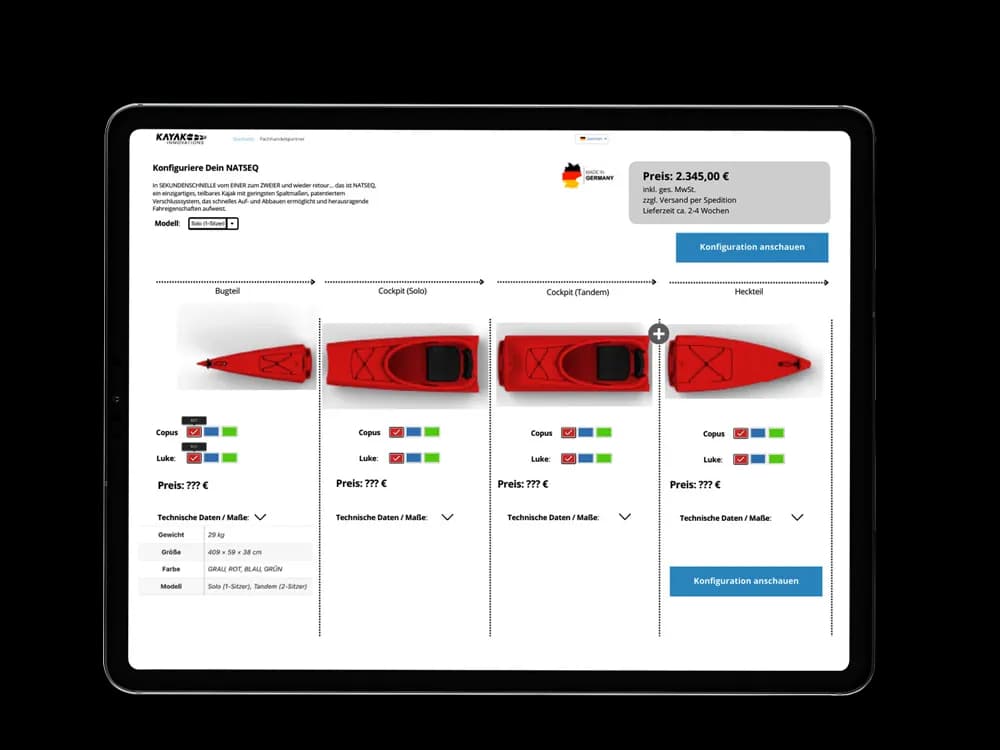
A customer answers a few questions, selects some options, and moments later the result is a product, a price, a qualified enquiry or even a finished order.
What sounds obvious today was still quite unusual more than 20 years ago. Back then we developed one of our first configurators for municipal utilities (Stadtwerke). Since then we have delivered hundreds of such solutions for a wide range of products, services and industries.
From electricity tariffs to conservatories, printed products, insurance, travel and machine tools, through to explosion protection consulting and technical expert knowledge.
One thing has remained the same over the years: a good product configurator is far more than a form with a few selection fields.
A good configurator makes knowledge, prices, products and processes usable digitally.
What is a product configurator?
A product configurator is software that assembles a specific product or service from various data, rules, options and dependencies.
Ideally, the user does not need to know anything about the complexity behind it. They answer questions about size, material, area of use, performance, quantity, location or budget, for example. In the background, the configurator checks which options fit together and guides the user step by step to a result.
The result can be, for example:
- an individually assembled product,
- a specific price,
- a qualified enquiry,
- an automatically prepared quotation,
- a technical product selection,
- an order,
- a production file
- or even a concrete recommendation for action.
Depending on the task, such a configurator can therefore also be a price calculator, tariff calculator, quotation configurator, product finder, guided selling system or part of a CPQ (configure, price, quote) solution.
The decisive question is not: which software do we need? It is: which decision, calculation or knowledge service do we want to map digitally?
This small tool generated millions
I still remember well the time when the liberalisation of the electricity market turned the energy sector upside down. Suddenly customers could choose their electricity supplier freely, regardless of who owned the local grid.
At the same time, grid operators had to open their networks to other suppliers and take the corresponding grid charges into account.
Sounds complicated? It is.
Together with one of our municipal utility clients, we came up with the idea of a small configurator.
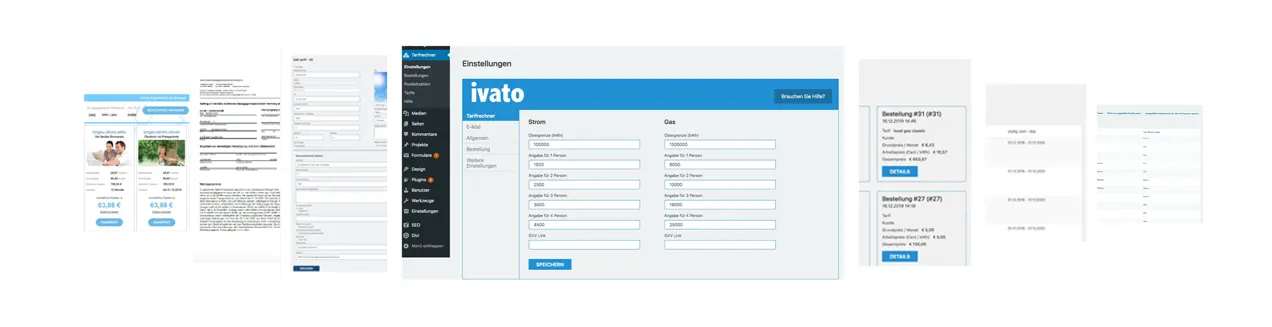
The customer only had to enter their postcode and annual consumption. In the background, the system checked the supply area, available products, consumption bands, prices and other parameters, and within a few seconds calculated a suitable tariff.
The customer could then order directly online.
We affectionately called it the Tarifrechner (tariff calculator).
This seemingly small tool later became a product that generated double-digit millions in revenue over the years.
At least for us. For the companies that used such systems in their sales, the value creation this made possible was correspondingly even greater.
And the interesting thing is that the basic idea still works today.
Why a product configurator can be so interesting for businesses
In our view, the biggest mistake is to regard a configurator merely as an additional function of a website.
Developed properly, it can change sales, consulting, calculation and internal processes at the same time.
Customers are pre-qualified
Instead of an enquiry such as "I am interested in a conservatory", sales receives information on size, ideas, location, budget and other relevant requirements.
The sales process no longer starts from zero.
Quotations can be produced faster
When relevant data is already available in structured form and pricing and product rules are stored in the system, numerous follow-up questions and manual steps are no longer needed.
Errors can be avoided
A rule-based configurator can prevent combinations that make no technical or economic sense. Certain options can be shown or hidden depending on one another. Limits and calculations can be taken into account automatically.
Expert knowledge becomes more scalable
It becomes particularly interesting when a service can normally only be provided by employees with many years of experience.
In that case, a considerable part of the company's value sits in the heads of individual people.
A custom configurator can turn part of this knowledge into questions, rules, decision paths and dependencies.
The configurator can be connected directly to other systems
A modern product configurator does not have to end at a contact form. The data it collects can be passed directly to CRM, ERP, shop, payment or production systems.
Product configurator example: from 10 to up to 100 quotations
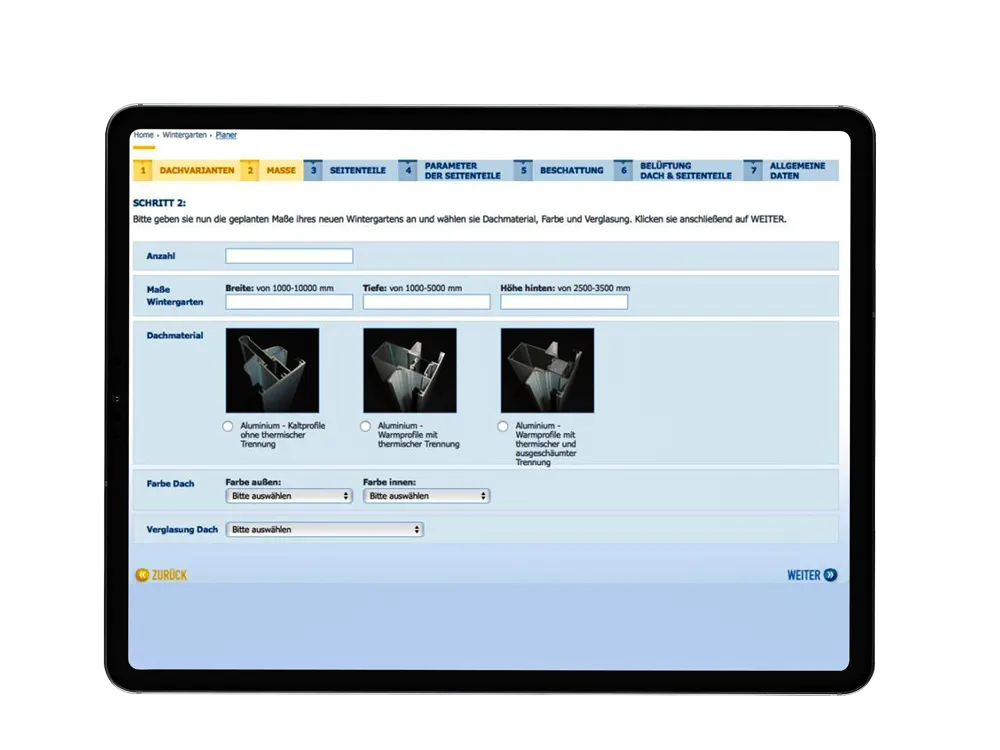
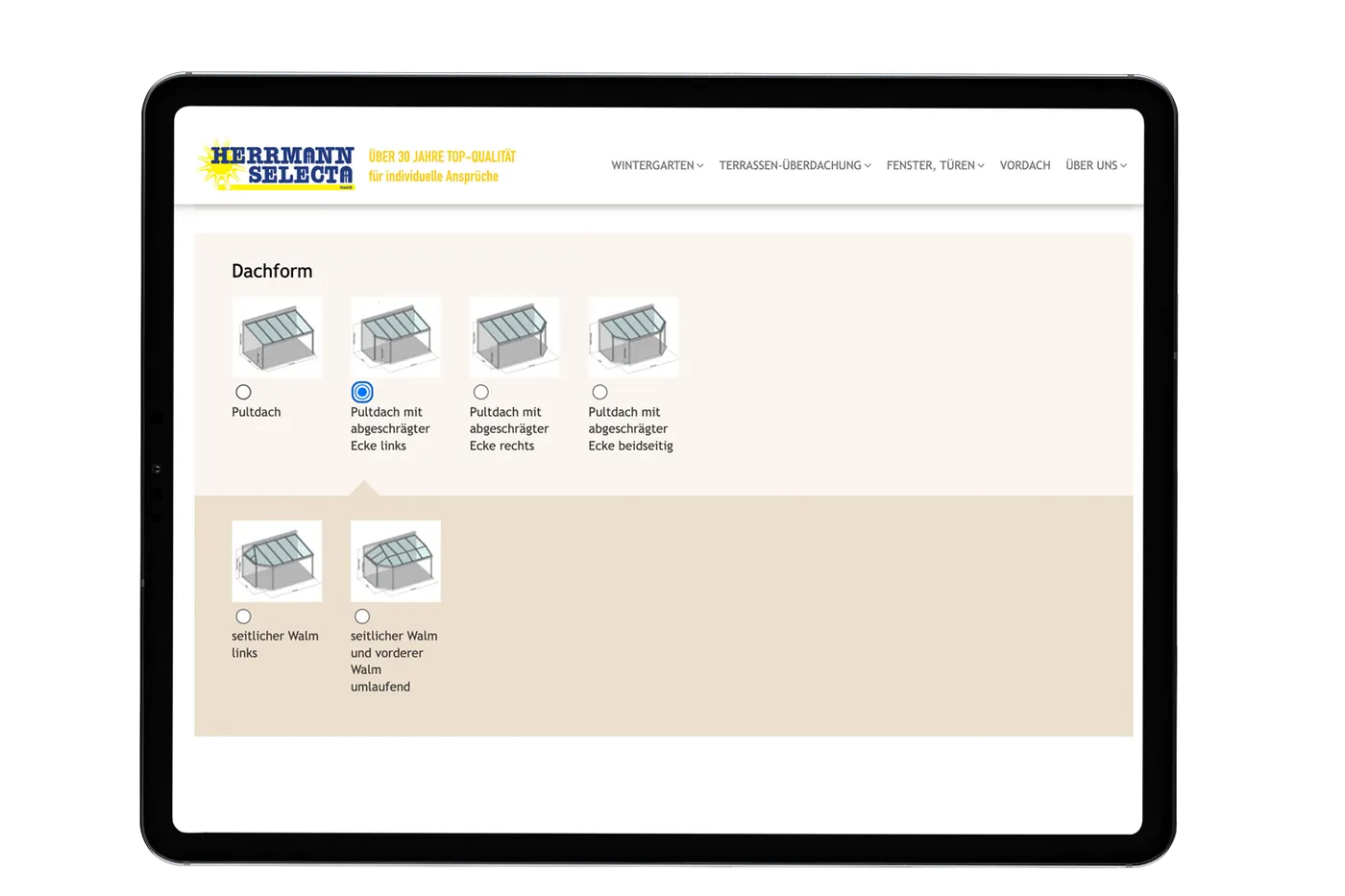
For a supplier of conservatories, patio roofs and larger window solutions, we developed a web-based configurator as early as around 2010.
The starting point will sound familiar to many mid-sized companies: prospects called, sent enquiries, dropped by in person or supplied only part of the information needed for a proper quotation.
The back office then had to keep asking the same basic questions.
We reversed this process.
Prospects were guided via landing pages, advertising and search engines to suitable reference projects and could then describe their requirements in a configurator.
Among other things, dimensions, ideas and further project data were requested. At the same time, the system explained the various options, so that even customers without technical knowledge were guided through the configuration step by step.
The information was then passed on to a connected CRM system.
The effect was enormous: where about 10 quotations could previously be processed, around 50 to 100 became possible later, based on project experience.
Not because employees suddenly worked ten times faster, but because a considerable part of the information gathering and pre-qualification was already automated.
Product configurator example: digitising expert knowledge
A completely different use case arose for a consultancy in industrial explosion protection.
Here the challenge was not different colours or product sizes.
The actual product was knowledge.
Assessing industrial plants required numerous factors to be taken into account: types of substances, hazard potentials, precautionary measures, spatial situations and many other dependencies.
A considerable part of this specialist knowledge was originally tied to the company's owner. This made growth difficult, because additional employees first had to build up a comparable level of knowledge.
Together, we therefore structured this knowledge over several months and translated it into digital decision logic.
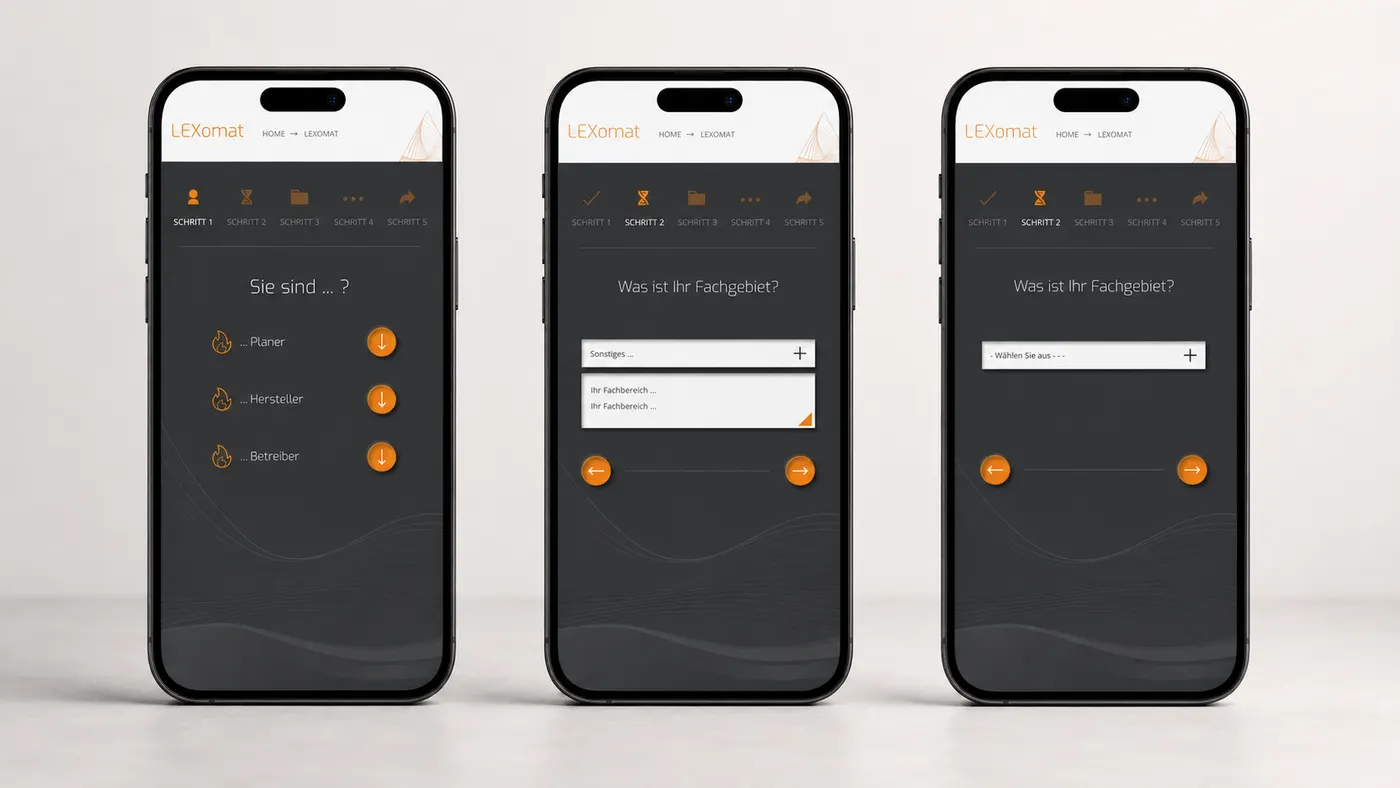
Internally, the system was named Lexomat.
A simplified version allowed prospects to pre-qualify their project. A much more extensive internal version supported employees in systematically recording and assessing complex projects.
The system asked detailed questions, drew on a knowledge library and could draw attention to possible problems.
Expert knowledge that was hard to scale became a digitally supported, reproducible consulting process.
Employees gained a clear thread to follow and could work far more systematically. At the same time, consultations and quotations were prepared faster and the chain of information became easier to follow.
Product configurator example: from click straight to production
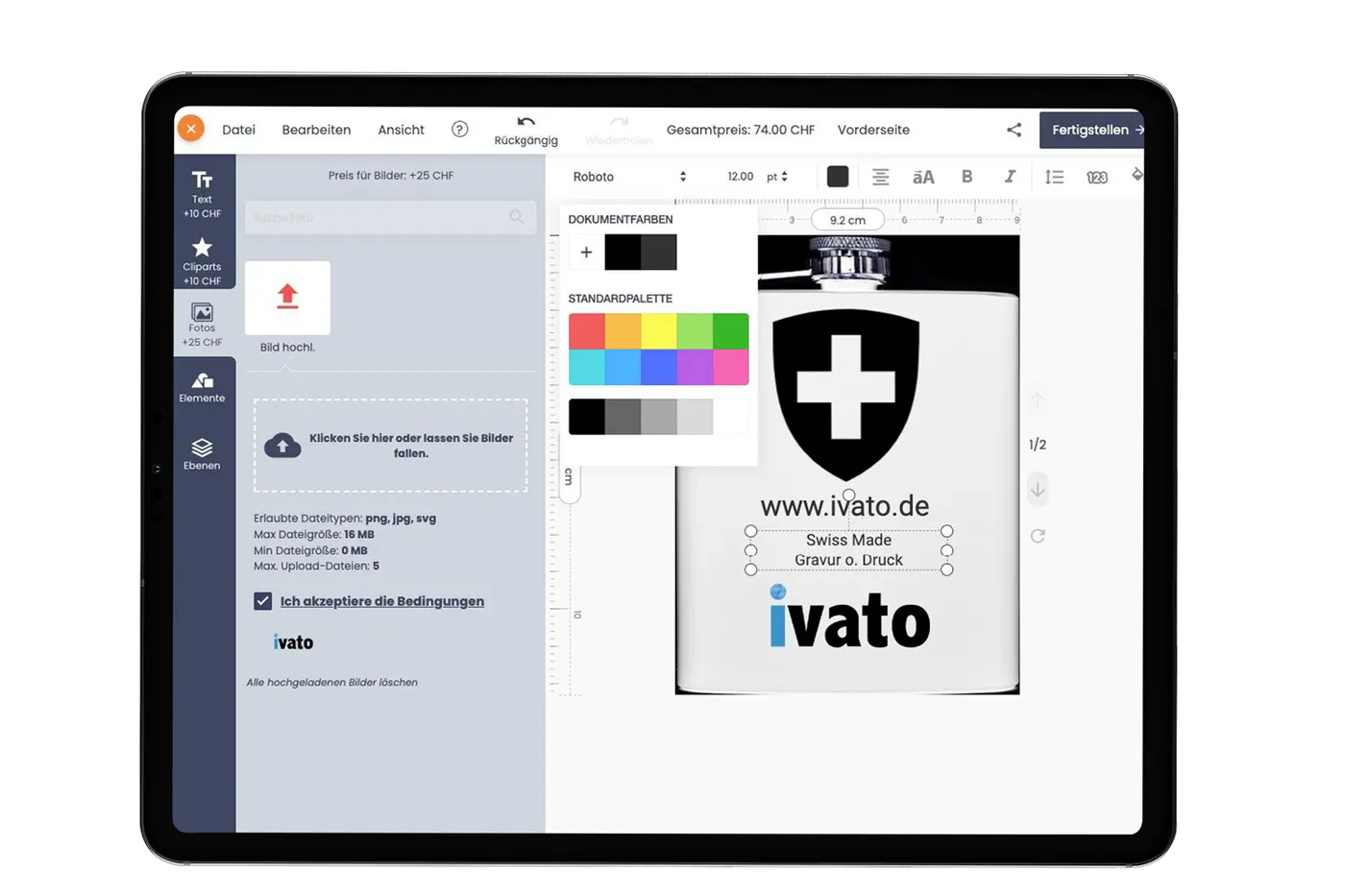
For a Swiss family business, we built a configurator for personalised printed and laser-engraved products.
Customers could design signs, bottles, pens, boards, hip flasks and other products directly online, for example.
A particular challenge was the different production methods.
Conventional printing allows different design options than laser engraving. The configurator therefore had to decide, depending on the chosen method, which options may be offered at all.
The digital process did not end after the order.
From the configuration, the system directly generated a technical file that could be used for production.
Configure → design → calculate price → order → pay → generate production file → manufacture → ship.
It is precisely at this point that a product configurator becomes more than a marketing tool. It becomes part of the actual business model.
What can you configure with a product configurator?
After hundreds of projects, our answer is now fairly simple:
Almost anything that can be described through questions, data, rules, formulas or dependencies.
Over the years, we have developed or supported configurators and calculation systems for the following areas, among others:
- electricity and gas tariffs,
- insurance products,
- conservatories and patio roofs,
- windows,
- printed products,
- laser engravings,
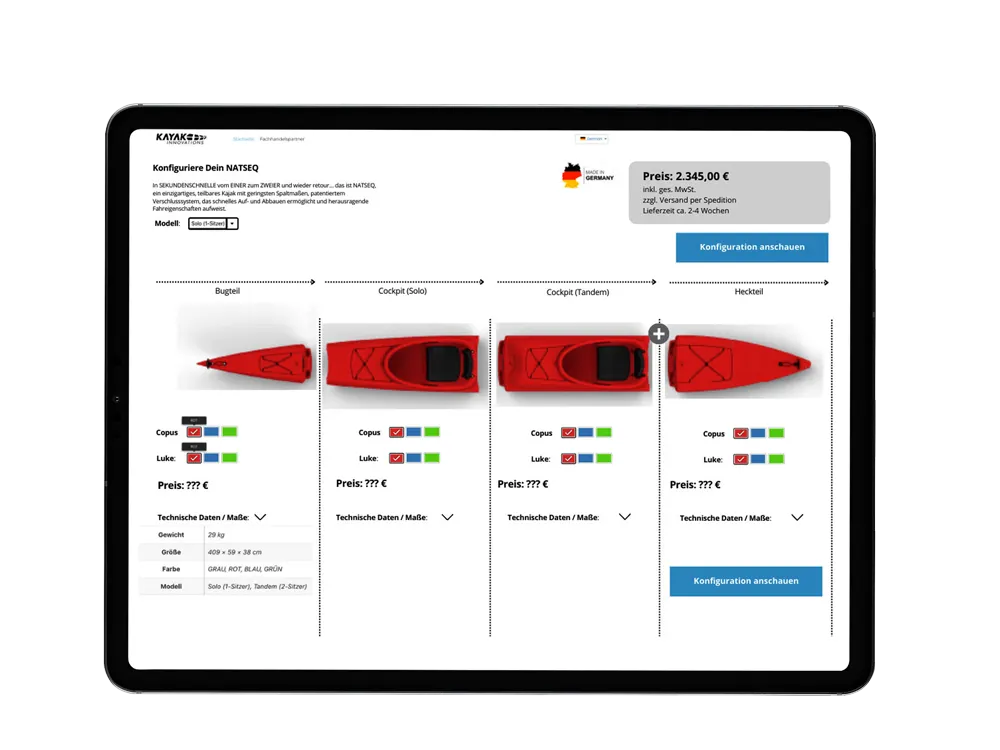
- kayaks,
- travel and hotel offers,
- services,
- telephone and DSL tariffs,
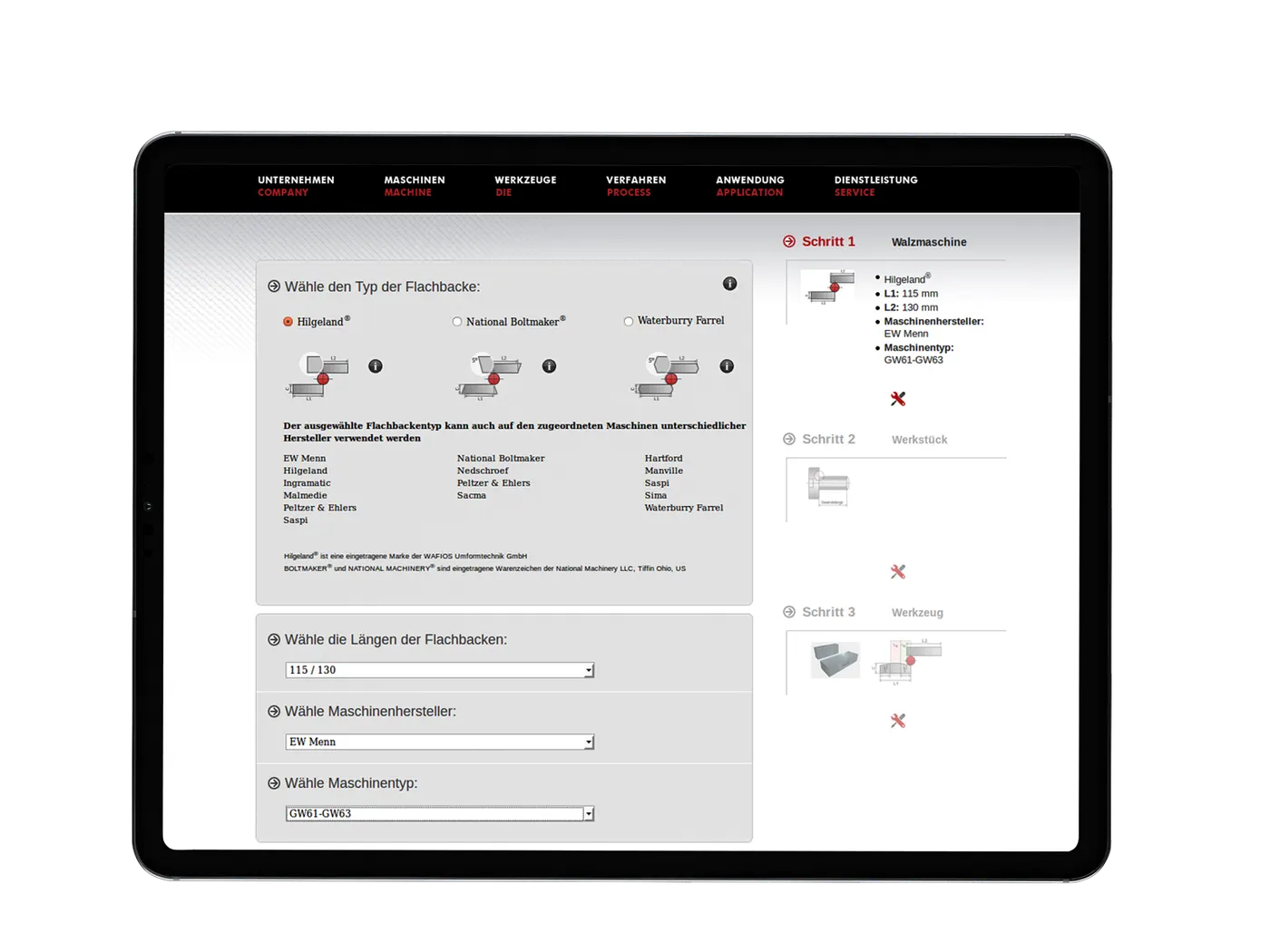
- machine tools,
- chocolate and coffee,
- clothing,
- technical sensor systems and circuit diagrams
- and complex consulting services.
What types of product configurators are there?
Product configurator
The user combines features, components or variants of a product. Rules ensure that only technically or economically possible combinations are created.
Price calculator and tariff calculator
A price or tariff is calculated automatically from data such as consumption, quantity, region or performance.
Quotation configurator
The user describes their need. From this information, a specific quotation can then be created automatically or semi-automatically.
Guided selling configurator
The prospect does not yet know exactly which product they need. The system asks questions about their needs and leads them to the right solution.
B2B configurator and CPQ
In B2B solutions, the focus is often on technical product rules, customer-specific prices, dealer structures, approvals and CRM and ERP interfaces.
Knowledge and consulting configurator
Here, parts of expert knowledge are translated into questions, rules and decision paths, making them systematically usable for employees or customers.
When is a custom product configurator worthwhile?
A product configurator should be considered in particular if several of the following points apply to your company:
- Customers keep answering the same questions.
- Quotations are calculated manually every time.
- There are a great many product variants.
- Certain options mutually exclude each other.
- Prices depend on several factors.
- The product needs explanation.
- Enquiries are often incomplete.
- Expert knowledge depends on individual employees.
- Data is entered manually several times.
- Sales, CRM, ERP and production still work largely separately.
- Complex products are to be sold online for the first time.
When is standard software enough and when do you need a custom configurator?
Not every project requires custom development.
Anyone who offers five products with only a few options each and simply wants to calculate a basic price may be well served by an existing modular system.
Custom configurator development becomes particularly interesting when the business logic itself is complex.
For example, because of:
- complex product dependencies,
- individual pricing and discount logic,
- customer-specific terms,
- CRM or ERP integration,
- automatic document generation,
- production data or bills of materials,
- existing databases
- or specialist expert knowledge.
How do you develop a good product configurator?
After more than two decades of experience with such projects, we know that the hardest part is rarely the programming itself.
The decisive work happens beforehand.
1. Define the business objective
Should more be sold? Should sales be relieved? Should customers be better pre-qualified? Should expert knowledge be scaled or production automated?
2. Capture product and decision logic
What information does an experienced employee need today to make the right decision? What questions does a good salesperson ask? Which combinations are possible and which are excluded?
3. Model rules and dependencies
This knowledge becomes a decision tree or set of rules. In complex projects, this structuring is often a major part of the work.
4. Keep operation simple
The logic behind a configurator may be extremely complex. For the user, it should appear as simple as possible.
5. Consider the downstream processes
What happens after the final click? This is often where the greatest automation lever lies. The data collected should be processed as directly as possible where it is needed next.
What does a custom product configurator cost?
There is no serious flat-rate answer to this.
A simple price calculator with a few dependencies is technically something entirely different from a B2B product configurator with thousands of rules, real-time calculation, user management, CRM and ERP integration and automatic quotation generation.
The cost is determined by factors including:
- number and complexity of the rules,
- scope of the product data,
- pricing logic,
- user guidance and visualisation,
- interfaces,
- administration interface,
- document or file generation
- and the desired degree of automation.
The more important question is therefore not initially: what does the configurator cost? It is: which process does it replace, speed up or make possible?
Connecting a product configurator to CRM, ERP and online shop
A configurator becomes particularly interesting when it is not viewed in isolation.
A sales process can look like this, for example:
Google → landing page → product configurator → qualified enquiry → CRM → calculation → quotation → order.
For a manufacturing company, it can become:
Select product → configure → calculate price → pay → generate production data → manufacture → ship.
The less data has to be re-entered manually along this path, the greater the economic benefit often is.
Perhaps the greatest advantage of a configurator
Companies often grow organically. A product is added. Then a special solution. Then another variant.
At some point, employee A knows the prices, employee B knows which combination is technically possible, and employee C knows the special rules of an important customer.
As long as all three are there, this works.
As the company grows, though, exactly this knowledge becomes a bottleneck.
Developing a configurator forces a company to structure this knowledge:
- What may be combined with what?
- How is a price arrived at?
- What information do we really need?
- When is a product technically feasible?
- What questions does a good salesperson have to ask?
Knowledge in individual heads becomes a system.
Why product configurators have occupied us for over 20 years
We could simply have regarded our first tariff calculator back then as a small internet tool.
Postcode in. Consumption in. Price out.
Done.
In hindsight, however, the key insight was a different one:
A concrete product emerged from a set of variable data.
It became calculable.
That made it orderable.
And it could then be produced or delivered systematically.
We have come across this principle again and again ever since, in energy products, printed products, conservatories, insurance, industrial products and even highly specialised expert knowledge.
For us, a product configurator is therefore not a form with a few dependencies. It is a way of translating part of a business model into software.
Do you want a custom product configurator developed?
Then we do not begin with the question of which programming language or configurator tool to use.
We first look at your product and the process behind it.
- Which variants exist?
- Where do follow-up questions arise today?
- What knowledge sits in your employees' heads?
- How are prices calculated?
- What happens after an enquiry?
- And where could a configurator make the biggest economic difference?
Only then does the technical solution emerge.
Do you want a product configurator, quotation configurator, price calculator or a custom CPQ solution developed? Arrange a no-obligation initial consultation with us.